
Doing 1000 Pull-Ups in 9 Hours
- Paul Cleveringa
- Sep 10, 2023
- 4 min read

Updated: Sep 23, 2023
Overview
In this 3 minute read you will:
Hear my experience doing 1000 pull-ups in 9 hours
Increase the number of pull-ups you can do
Learn to do your first pull-up
Story Time
On Saturday, September 9, 2023 I did 1,000 pull-ups.
I started at 5:30am and finished around 2:30 pm. I did 200 sets of 5 reps. I took several breaks and even grocery shopped in between.
At 5:30 am, I devoted two hours to pull-ups and did 450 reps.
I didn’t eat anything before these reps and only had some sea salt and water. As I did these initial reps, I began to get hungry. My body was realizing what we were doing and it requested fuel. After 450 reps, I got breakfast consisting of oats, blueberries, chia seeds, a banana, and a black coffee.
As my food digested, I went back to the gym and did sets of 5 pull-ups until I got to 635.
I needed another break.
My forearms were beginning to cramp and my right shoulder was getting sore. I decided to go grocery shopping for a break from pull-ups. Surprisingly, my back still felt strong and my hands were not that raw and did not have any tears. I actually ended up going the full 1000 pull-ups without tearing any skin on my hands.
As I arrived home from grocery shopping, I did more pull-ups in my apartment using a doorframe pull-up bar.
Throughout the rest of the morning and early afternoon, I did sets of 5 reps until I reached 1000.
It was a fun and rewarding challenge.
I am surprised at how well my body recovered between sets to be able to do 200 sets of 5 reps.
Recommendations To Do a Lot of Pull-Ups
The best way to get better at anything is to do more of it.
Doing more of something will, most of the time, get you better at that thing.
If you want to get better at pull-ups, do more pull-ups. Gradually increase how many pull-ups you are doing in a workout, in a day, and in a week. This gradual increase in volume over time will increase the amount of pull-ups you can do.
To train for the 1000 pull-ups, I started doing about 100 pull-ups a day for five to six days a week. Then I increased that volume to do 200, 300, and even 600 pull-ups days. Gradually increasing volume is imperative to reduce the chance of injury.
A couple months ago when I first began training, I did too many pull-ups too soon.
My muscles were performing, growing, and ready to keep going, but my tendons and ligaments in my left shoulders were not improving at the same rate as my muscles. I ended up hurting my left shoulder because of this. Tendons and ligaments take longer to get stronger than muscles and this is something I knew, but was ignorant to.
I learned my lesson and let my shoulder fully heal.
It only took about a week to heal as the injury was not bad. I began my training again and started slow with consistent days of about 30-50 reps. Each week I increased the daily volume and did not experience any shoulder pain.
Gradual increases, with consistent work creates results.
How To Do Your First Pull-Up
If you are unable to do pull-ups, I recommend that you do assisted pull-ups by using a barbell in a squat rack or a smith machine.
Lower the bar to about your chest height and set up under it like you are doing a pull-up. Because the bar is lower, you can put your feet out in front of you, taking weight off. Instead of doing a pull-up with your full bodyweight, now you are practicing pull-ups with weight that is lower than your bodyweight (see the below picture for an example).
The more you put your feet underneath your body and bar, the more weight you will be taking off.
To progress, after being able to do 8-12 reps with your feet underneath you, start moving your feet out in front of you. Once they are fully extended in front of you and you can do 8-12 reps, you are ready to start practicing bodyweight pull-ups.

Assisted pull-ups
Accessory Exercises For Pull-Ups
Scapula Pulls
Hanging From The Bar
Hollow Body Holds
A pull-up uses your body’s full kinetic chain.
This means that you use your upper and lower body when doing a pull-up. A pull-up requires you to use your back (mainly lats), shoulders, biceps, forearms, hands, and your core, hip flexors, and glutes to stabilize yourself when performing a rep.
Therefore, I am not a fan of doing lat pulldowns to get better at pull-ups because it is not using your body’s full kinetic chain.
Instead, I prefer to do exercises that improve my pull-up technique and use the kinetic chain.
For example, in my training I did scapula pulls to strengthen my scapula muscles to ensure I am performing the correct technique of a pull-up.
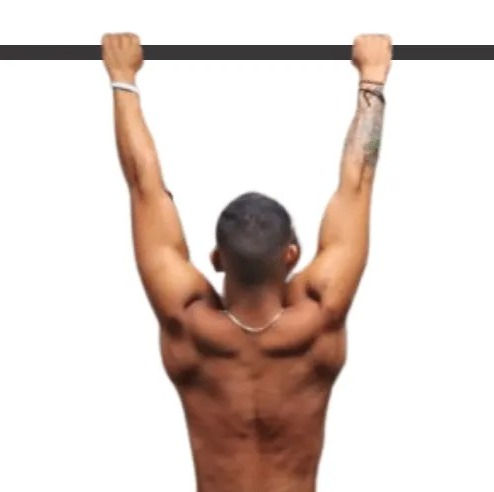
When pulling your body up, you pinch your scapula blades together and pull them down to ensure you are using as much muscle as possible. To perform a scapula pull, hang from a bar and keep your arms straight. Focus on just pulling your shoulder blades together and down (see image below for example).
I also would hang from the bar with one arm and two arms for time to increase my grip strength. Your grip can often be the first thing that gives when doing pull-ups.
The final exercise that I did was hollow body holds. This is a full kinetic chain exercise that works on your core and stabilization. I would often hold the positive for a few sets of 30 seconds to a minute. See below for a picture of each of these exercises.

Scapula Pulls
Hanging From Bar (one arm and two)

Hollow Body Hold
Takeaways
Start slow
Gradually increase volume
Consistent work
Accessories to target weaknesses
Enjoy the process
To get better at pull-ups, you have to increase the amount of pull-ups you are doing.
Determine how much volume of pull-ups you do now and gradually begin to increase that. Consistently doing pull-ups over a long period of time will get you better at them.
Also include accessory exercises into your workout routine once or twice a week to ensure you are addressing any weak muscles or muscle imbalances (one side of your body being noticeably weaker than the other).
If you are working towards your first pull-up, don’t worry, you will be able to do one in no time. Begin by doing the assisted pull-ups with your feet underneath you and gradually increase reps and decrease the amount of bodyweight you are taking off.
Good luck on your pull-up journey!


Comments